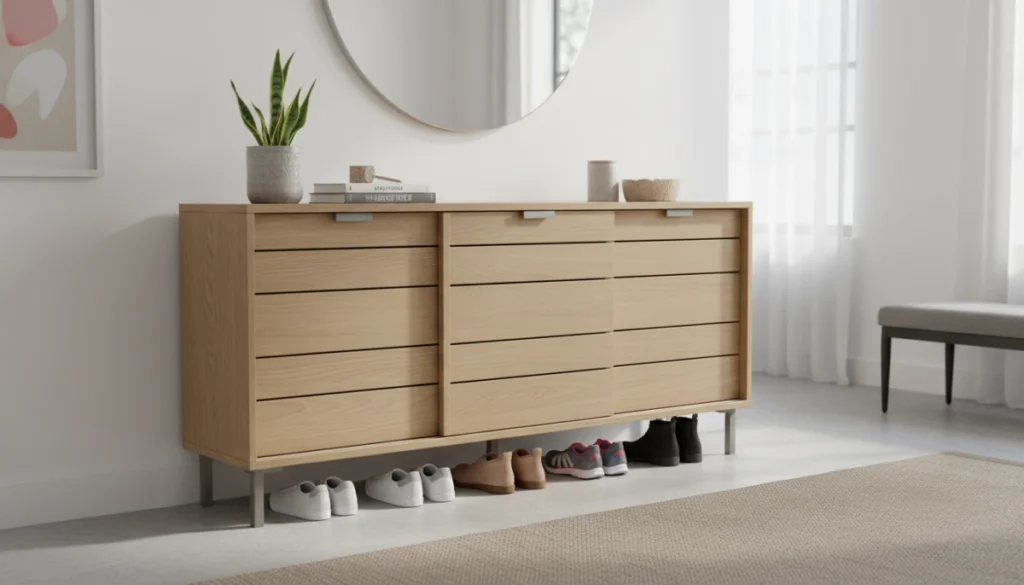
If your entryway feels like a shoe explosion, you’re not alone. Piles of sneakers by the door, boots leaning against the wall, and no clear place to put anything—it all adds up to daily visual stress.
A well-chosen shoe cabinet fixes that in one move.
The right piece doesn’t just hide clutter. It turns your foyer into a calm, intentional space: a slim tilt-out shoe cabinet for a narrow hallway, a shoe storage bench with seat for busy families, or a solid wood shoe cupboard that anchors a modern entryway.
In this guide from lifenotesjournal, you’ll see exactly how to:
- Match a shoe cabinet to your space, shoe collection, and lifestyle
- Choose between open racks, hidden footwear storage, and space-saving vertical designs
- Style the top like a mini console so your entry feels curated, not crowded
If you’re ready to trade “pile of shoes” for a clutter-free, welcoming entryway, keep reading.
Shoe Cabinet Basics: What You Really Need
If your entryway is a minefield of random shoes, you don’t need more willpower—you need a good shoe cabinet. A simple, well-designed entryway shoe cabinet turns that first step into your home from chaos into calm.
Why a Shoe Cabinet Matters
A shoe cabinet solves daily headaches fast:
- No more piles of shoes by the door
- Fewer tripping hazards in a narrow hallway or small foyer
- Less visual mess the second you walk in
- A clear spot where everyone knows shoes live
Instead of kicking shoes aside, you open your shoe organizer cupboard, slip them in, and your entryway looks “guest-ready” in seconds.
Problems a Shoe Cabinet Instantly Solves
A well-sized shoe cabinet for narrow hallway or small apartment living tackles:
- Clutter: Shoes disappear behind closed doors instead of lining every wall
- Dirt: Dirt stays contained on shelves or trays, not all over your floors
- Stress: A tidy, closed door shoe cabinet makes the whole entry feel calmer
- Lost pairs: Designated spaces mean you actually find matching shoes on busy mornings
Storage and Style Upgrade
The right shoe cabinet does more than hide sneakers:
- Acts like entryway storage furniture and a visual anchor by the door
- Gives you a clean surface for keys, mail, and a small tray
- Adds style, whether you prefer a modern shoe cabinet design or a more rustic look
- Helps your home feel intentional, not temporary or cluttered
Even a slim profile shoe cabinet can look like a built-in piece when you match it to your decor.
Key Decisions Before You Buy
Before you click “add to cart,” lock in these basics:
- Space: Measure your wall width and depth so the shoe cabinet doesn’t block pathways
- Capacity: Count how many pairs you actually need to store (not just your favorites)
- Type: Decide between a vertical shoe cabinet, tilt-out shoe cabinet, or a shoe storage bench cabinet with seating
- Material: Choose between an engineered wood shoe cabinet, solid wood shoe cabinet, or metal shoe storage cabinet based on budget and durability
- Look: Pick a minimalist shoe cabinet, modern design, or something more classic that fits the rest of your furniture
When you get these decisions right, your shoe cabinet stops being “just storage” and becomes the quiet hero of your entryway.
Measure Your Space Before Buying a Shoe Cabinet
Before I add any shoe cabinet to an entryway, I treat measurements like a non‑negotiable. A few minutes with a tape measure saves you from returns, blocked doors, and stubbed toes.
How To Measure For A Shoe Cabinet
Use a tape measure and write everything down:
- Width – Measure the wall where your entryway shoe cabinet will go, from edge to edge. Subtract at least 3–4 inches on each side so it doesn’t feel crammed or crowd outlets and switches.
- Depth – From the wall out toward the room, measure how far you can go without blocking the walkway. In narrow hallways, I keep depth to 7–10 inches with a slim profile shoe cabinet or tilt-out shoe cabinet.
- Height – Measure from the floor to light switches, windowsills, or wall decor. For small foyers, I like shoe cabinets around 30–36 inches high so the top can double as a drop zone for keys and mail.
Check Door And Drawer Clearance
A shoe cabinet that can’t open fully is basically useless. I always check:
- Front clearance – After you measure depth, leave at least 24–30 inches in front so doors, drawers, or tilt-out fronts can open and someone can stand there.
- Door swing – Open your entry door all the way and measure the arc. Make sure the shoe cabinet for narrow hallway areas sits outside that swing so the door never slams into it.
- Nearby furniture – If you have a console table, coat rack, or bench, measure the space between pieces so you can still move comfortably.
Fitting Shoe Cabinets In Tight Spaces
For small apartments, narrow entryways, and compact foyers, I focus on space-saving shoe storage:
- Slim profile shoe cabinet – Go shallow on depth (under 10 inches) and use a vertical shoe cabinet to go taller instead of wider.
- Tilt-out shoe cabinet – Great along apartment hallways because the doors tilt instead of swinging wide into the walkway.
- Corner spots – Tuck a small entryway shoe cabinet near the front door but out of the traffic line, especially in city apartments where every inch counts.
When the measurements line up with your door swing and furniture layout, your shoe cabinet feels built in, not squeezed in—and your entryway actually works for real life.
Shoe Cabinet Capacity And Shoe Collection Size
How Many Pairs Should Your Shoe Cabinet Hold?
Before you buy an entryway shoe cabinet, I always recommend doing a quick shoe count:
- Pull out all shoes that actually live near the door.
- Group by owner (you, partner, kids) and by type (sneakers, work shoes, sandals, boots).
- Count everyday pairs first, then add 10–30% extra capacity for new shoes and guests.
For most U.S. households:
- Singles or couples: aim for a 12–20 pair shoe cabinet.
- Families: plan for a 24–40 pair large capacity shoe cabinet or two smaller units.
Everyday Shoes vs Rarely Worn Pairs
Your shoe cabinet should put daily shoes front and center:
- Reserve prime eye-level shelves for everyday sneakers, slip-ons, and work shoes.
- Use higher or lower shelves for dress shoes, heels, and special-occasion pairs.
- Off-season shoes (winter boots in summer, sandals in winter) can move to:
- The top of a vertical shoe cabinet
- Bins inside a shoe organizer cupboard
- Bedroom or closet storage
This way, the shoe cabinet stays fast to use during rushed weekday mornings.
Storing Boots, Heels, And Big Sneakers In A Shoe Cabinet
Not every shoe fits in a slim profile shoe cabinet, so I plan layouts around “problem” shoes:
Tall boots
- Look for at least 16–18 in of vertical space or a dedicated boot section.
- Use boot shapers or hangers so they don’t flop and crease.
High heels
- Heels usually fit fine in most tilt-out shoe cabinets and standard cupboards.
- Keep heel tips away from cabinet backs to avoid scuffs; slightly angled shelves help a lot.
Large men’s sneakers (US size 11 and up)
- Choose a deeper shoe cabinet or adjustable shelves; very slim entryway cabinets can crush the toe box.
- Sideways or heel-to-toe placement can help maximize space in a narrow entryway storage cabinet.
How Shelf Depth And Height Affect What Fits
Shelf dimensions are what make or break a space-saving shoe storage setup:
Depth (front to back)
- 8–9 in: best for slim sneakers, flats, kids’ shoes; ideal for a slim shoe cabinet for narrow hallways.
- 10–12 in: more flexible; handles most adult sneakers and casual shoes comfortably.
- 13–14+ in: needed for wide athletic shoes, work boots, and bulky running shoes.
Height (between shelves)
- 4–5 in: flats and sandals only.
- 6–7 in: everyday sneakers and low boots.
- 10–18 in: tall boots and stacked shoeboxes.
When I design or pick a modern shoe cabinet design for U.S. homes, I always push for adjustable shelves. They let you reconfigure the shoe cabinet as your collection changes, whether you’re adding more dress boots, high heels, or kids’ sports shoes over time.
Types of Shoe Cabinets for Different Homes
Tilt-Out Shoe Cabinet for Narrow Entryways
A tilt-out shoe cabinet is one of my go-to options for a slim, space-saving entryway shoe cabinet. The doors tilt forward, so the unit stays shallow and doesn’t eat into your hallway.
Best when you:
- Have a narrow hallway or condo entry
- Want a slim profile shoe cabinet that doesn’t block the door
- Mainly store flats, sneakers, and low-profile shoes
Keep in mind:
- Not ideal for tall boots or bulky work shoes
- You’ll want a stable wall mount in high-traffic areas
Shoe Cabinet Bench with Seating for Mudrooms and Families
A shoe cabinet bench with seating turns your entry into a functional landing spot, especially for families.
Why it works:
- Built-in bench makes it easy to sit and put on shoes
- Hidden shoe storage cabinet keeps kids’ shoes off the floor
- Great for mudroom shoe cabinet ideas in busy households
Nice-to-have features:
- Removable cushions for easy cleaning
- Separate cubbies for kids, adults, and sports shoes
Cupboard-Style Shoe Cabinet for Bigger Collections
If you own a lot of shoes, a standard cupboard-style shoe organizer cupboard gives you full-height storage with adjustable shelves.
Best for:
- Large capacity shoe cabinet needs (sneakers, heels, boots)
- Bedrooms, walk-in closets, or wide foyers
Look for:
- Adjustable shelves for boot storage in a shoe cabinet
- Solid wood shoe cabinet or durable engineered wood cabinet for long-term use
Open Shoe Rack vs Closed Shoe Cabinet Doors
Both open and closed entryway storage furniture have a place, but they solve different problems.
| Option | Pros | Cons |
|---|---|---|
| Open shoe rack | Easy access, shoes dry faster | More dust, visual clutter, harder to hide |
| Closed door shoe cabinet | Cleaner look, hides mess, less dust | Slightly slower access, needs ventilation |
| Hidden shoe storage cabinet | Looks like regular furniture, discreet | Usually higher price point |
If you want a calm, tidy entry, I always lean toward a closed door shoe cabinet or hidden shoe storage cabinet.
Vertical Shoe Cabinet for Small Floor Spaces
A vertical shoe cabinet stacks storage upward, not outward, which is ideal for tight spots.
Great for:
- Small apartment shoe cabinet setups
- Narrow entryway storage next to the door
- Studio spaces that need multi-purpose hallway cabinets
Tips:
- Choose a tall, vertical shoe cabinet with a slim depth
- Anchor it to the wall for safety in family shoe storage solutions
Tilt-Out Shoe Cabinet: Space-Saving Storage
A tilt-out shoe cabinet is one of my favorite space-saving shoe storage ideas for tight entryways and small apartments. Instead of deep shelves, the doors pull forward on a tilt, and the shoes sit in angled metal or plastic racks. You get real shoe capacity in a very slim profile shoe cabinet that doesn’t eat up your hallway.
How a Tilt-Out Shoe Cabinet Works
- The front panel pulls out on a hinge, usually from the bottom.
- Inside, angled racks hold shoes heel‑down so they stack neatly.
- Most tilt-out shoe cabinets are shallow (often 6–8\” deep), perfect as an entryway shoe cabinet in a narrow hallway.
- You can usually fit 2–3 pairs per compartment, depending on shoe size.
Best Places To Use a Tilt-Out Shoe Cabinet
A tilt-out shoe cabinet shines wherever floor space is tight:
- Narrow entryway storage next to the front door
- Small apartment shoe cabinet in a studio or condo
- Behind a door or along a tight hallway where a regular shoe organizer cupboard would stick out too far
- Foyer shoe storage ideas where you want a “hidden shoe storage cabinet” that looks like normal entryway storage furniture
Pros and Cons by Shoe Type
What tilt-out shoe cabinets are great for:
- Everyday sneakers and casual shoes
- Flats, sandals, and kids’ shoes
- Most low and mid-height men’s and women’s shoes
What they’re not great for:
- Tall boot storage in a shoe cabinet (knee‑high or over-the-knee boots often don’t fit)
- Very high heel shoe cabinet storage where long heels can snag or hang awkwardly
- Wide or very large men’s sneakers in some slim models
When a Tilt-Out Shoe Cabinet Is Not the Right Choice
Skip a tilt-out design and look at a standard cupboard-style or vertical shoe cabinet if:
- You have lots of tall boots or bulky athletic shoes
- You want a shoe cabinet with seating (a shoe storage bench cabinet is better for families and mudrooms)
- You need heavy-duty space for work boots and outdoor gear
- You prefer fully adjustable shelves over fixed tilt racks
In most small US homes and apartments, a tilt-out shoe cabinet is a smart, space-saving shoe storage upgrade, as long as your everyday shoes are mostly low-profile.
Shoe Cabinet Bench: Storage You Can Sit On
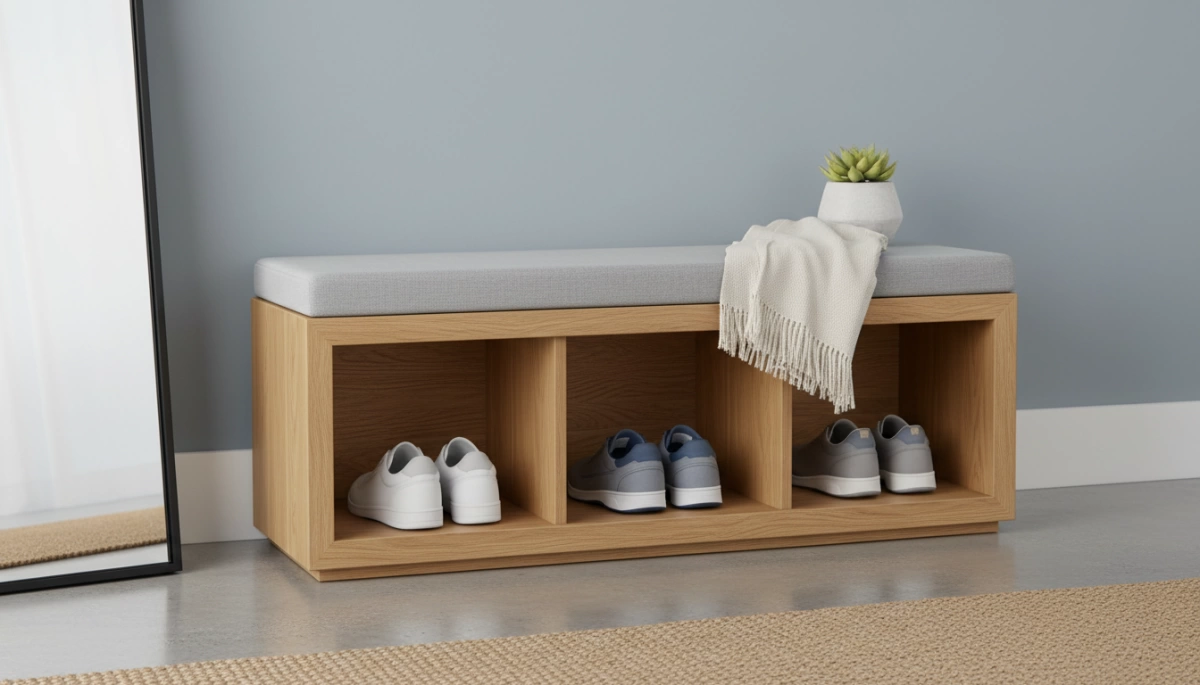
A shoe cabinet bench is one of the most practical entryway pieces I offer. It combines a slim profile shoe cabinet with a sturdy seat, so you get space-saving shoe storage and a place to sit while you put shoes on.
Benefits Of A Shoe Cabinet Bench In An Entryway Or Mudroom
A good shoe storage bench cabinet gives you:
- Sit-down comfort: No more hopping on one foot; the bench supports kids, adults, and seniors.
- Hidden shoe storage: Closed-door shoe cabinet sections keep piles of shoes out of sight.
- Fast drop zone: Perfect for busy mornings and after-school chaos in U.S. households.
- Space efficiency: One compact entryway shoe cabinet replaces a separate bench and rack.
| Benefit | Why It Helps In U.S. Homes |
|---|---|
| Seating + storage | Ideal for tight entryways and mudrooms |
| Closed cabinet doors | Cuts visual clutter and keeps floors clear |
| Lower height design | Easy access for kids and older family members |
Keeping Kids’ Shoes Organized In A Bench Shoe Cabinet
For family shoe storage solutions, a bench cabinet keeps kids’ shoes under control:
- Give each child a labeled cubby or bin under the bench.
- Keep everyday sneakers and school shoes in the easiest-to-reach section.
- Use closed door shoe cabinet sections for sports cleats and seasonal shoes.
- Add a shallow top drawer for socks, laces, and small gear.
How To Choose Cushion, Height, And Layout
When I design a shoe cabinet with seating for U.S. customers, I focus on comfort and function:
Height:
- Aim for 17–19 inches overall seat height (standard chair height).
- Make sure you can sit and tie shoes without knees feeling too high.
Cushion:
- Choose a firm foam cushion so it doesn’t bottom out.
- Go with washable, stain-resistant fabric or faux leather for families and pets.
Storage layout:
- Mix tilt-out shoe cabinet sections for slim everyday shoes.
- Add open cubbies for kids and boots.
- Use at least one closed compartment for messier pairs and sports gear.
| Feature | What To Look For |
|---|---|
| Height | 17–19\” seat height |
| Cushion | Firm, easy-clean, removable cover |
| Storage mix | Cubbies + tilt-out + closed compartments |
Using A Shoe Cabinet Bench As A Multi-Purpose Hallway Station
A shoe cabinet bench can anchor your whole hallway:
- Set it near the front door as your narrow entryway storage hub.
- Use hooks and a small shelf above for bags, backpacks, and jackets.
- Keep keys, mail, and a small tray on top (or in a drawer) for quick grab-and-go.
- In apartments, let it double as a multi-purpose hallway cabinet for umbrellas, dog leashes, and small packages.
Used right, a shoe cabinet bench turns a messy entry into a clean, efficient station you use every single day.
Classic Shoe Cabinet Cupboard for Large Collections
If you own a lot of shoes, a classic full-height shoe cabinet cupboard is the most efficient way to keep everything under control.
Why a Full-Height Shoe Cabinet Works
A full-height closed door shoe cabinet gives you:
- Serious capacity – A large capacity shoe cabinet can hold everyday sneakers, dress shoes, heels, boots, and seasonal pairs in one vertical shoe cabinet footprint.
- Better use of wall space – Instead of spreading multiple racks across the entryway, I stack storage up, not out, which is crucial in U.S. homes where the entryway competes with living and dining areas.
- Hidden shoe storage cabinet – Doors keep shoes out of sight, so your foyer looks like furniture, not a locker room.
Adjustable Shelves for Flexible Storage
Inside a modern shoe cabinet design, adjustable shelves are non-negotiable:
- Raise or lower shelves for boot storage in a shoe cabinet, high heels, or big men’s sneakers.
- Create separate zones for family shoe storage solutions: kids’ shoes lower, adults higher.
- Add a few taller cubbies for baskets or bins so the cabinet doubles as a shoe organizer cupboard and gear station.
Hiding Visual Clutter with Closed Doors
For an entryway shoe cabinet, closed doors are a game changer:
- You can keep a large capacity shoe cabinet fully loaded without visual chaos.
- A closed door shoe cabinet helps the entry feel calm, clean, and more like a living space than a drop zone.
- Handles and hardware let you style it as part of your entryway storage furniture, not just “shoe storage.”
Design Tips for Placing a Large Shoe Cabinet
When I place a full-height shoe cabinet in a U.S. home, I keep it simple:
- Line it up on a flat wall near the main entry or mudroom, away from door swing and walkway.
- Choose finishes that match existing trim and furniture: white for modern shoe cabinet design, warm wood for traditional, darker tones for a more minimalist shoe cabinet look.
- Treat the top surface like a console: a tray for keys, a small lamp, and a mirror above turns a big cabinet into a polished foyer shoe storage idea instead of a bulky box.
Open Shoe Rack vs Closed Shoe Cabinet Doors
When an open shoe rack or cabinet makes sense
An open shoe rack works when you:
- Want grab-and-go access by the front door for daily sneakers, slides, and kids’ shoes.
- Live in a drier, low-dust area and don’t mind seeing your shoes.
- Need a budget-friendly, space-saving shoe storage solution you can move around easily.
- Use it in a mudroom or garage where a casual, exposed look fits the space.
For narrow entryways, a slim profile shoe rack or vertical shoe cabinet with a few open cubbies can keep your “in rotation” pairs handy without eating up floor space.
Dust, odors, and visual clutter with open shoe storage
Open entryway shoe racks have some trade-offs:
- Dust buildup: Shoes collect dust faster when they sit out in the open.
- Odor spread: Gym shoes and work boots can make the whole entry smell if they’re not contained.
- Visual noise: Seeing every pair all the time makes small foyers and apartments feel messy, even when everything is lined up.
If you go with open shoe storage, I’d keep it to just a few pairs per person and rotate off-season shoes into a closed shoe cabinet or closet.
Why closed shoe cabinet doors feel calmer
A closed door shoe cabinet instantly cleans up the look of your entryway:
- Hides mismatched shoes, kids’ clutter, and bulky boots behind doors.
- Helps control odors and keeps dust off your shoes when paired with basic ventilation.
- Makes a small apartment entryway, hallway, or condo foyer feel more like a finished room and less like a locker room.
I lean toward a modern shoe cabinet design with flat-front or louvered doors for most U.S. homes because it doubles as entryway storage furniture and keeps the space calm.
Combining open and closed shoe cabinet storage
The best setup in real life is usually a mix:
- Use a closed shoe cabinet (tilt-out shoe cabinet, vertical shoe cabinet, or solid wood shoe cabinet) for most of your collection and off-season shoes.
- Add a small open shoe rack or an open section in a shoe storage bench cabinet for the 1–2 pairs you wear every day.
- Keep the open pairs low and easy to reach for kids; stash the rest behind closed doors for a cleaner look.
This “open for daily, closed for the rest” approach gives you fast access, better odor and dust control, and a tidy, minimalist shoe cabinet look in any entryway or narrow hallway.
Best Materials For a Durable Shoe Cabinet
When I design a shoe cabinet for everyday U.S. homes, I focus on three materials: engineered wood (MDF), solid wood, and metal. Each fits a different lifestyle, budget, and entryway shoe cabinet style.
Engineered Wood (MDF) Shoe Cabinet Pros and Cons
An engineered wood shoe cabinet is the go-to for a clean, modern shoe cabinet design at a lower price.
Pros:
- Budget-friendly: Great if you want a slim profile shoe cabinet or hidden shoe storage cabinet without spending a lot.
- Smooth finish: Takes paint and laminates well, perfect for white, black, or wood-look entryway storage furniture.
- Consistent look: No knots or grain variations, so it matches easily with other furniture.
Cons:
- Moisture-sensitive: Not ideal for very wet mudrooms or if shoes sit inside soaking wet.
- Less durable: Over time, edges can chip or swell if not cared for.
- Weight: MDF shoe cabinets can be heavy, especially tall vertical shoe cabinets.
Solid Wood Shoe Cabinet: Long-Term Durability and Warmth
A solid wood shoe cabinet is what I recommend if you want furniture-level quality that ages well and fits higher-end homes.
- Durability: Handles daily use, heavy boots, and family shoe storage solutions much better than cheaper options.
- Warmth and character: Ideal for farmhouse, rustic, or Scandinavian minimalist shoe cabinets.
- Refinishing: You can sand, stain, or repaint a solid wood shoe cabinet instead of replacing it.
- Best use: Great for an entryway shoe cabinet or shoe organizer cupboard that doubles as a statement piece.
If you’re in a colder U.S. climate with winter salt and mud, I always suggest solid wood with a strong finish plus a mat inside.
Metal and Industrial-Style Shoe Cabinets for Heavy Use
A metal shoe storage cabinet or industrial-style shoe cabinet shines in high-traffic, hard-working spaces.
- Heavy-duty: Perfect for garages, mudroom shoe cabinet ideas, kids’ sports gear, and work boots.
- Easy to clean: Wipe down quickly after rain, snow, or dirt.
- Slim options: Many vertical shoe cabinet and tilt-out shoe cabinet designs in metal are very space-saving.
- Look: Fits modern, loft, or industrial interiors; pairs well with concrete, black hardware, and simple lines.
If you want a mudroom or laundry room cabinet that can take abuse, metal is a safe bet.
Choosing Finishes and Colors to Match Your Interior Style
For U.S. homes, I keep shoe cabinet finishes simple and coordinated with existing furniture and floors.
- White or light colors: Ideal for small apartment shoe cabinets and narrow entryway storage; makes tight spaces feel bigger.
- Black or dark tones: Works with modern shoe cabinet design and minimalist shoe cabinet setups; hides scuffs.
- Wood tones: Oak, walnut, and light ash pair well with most living room and hallway furniture.
- Hardware: Match cabinet handles to your door hardware or light fixtures (black, brushed nickel, brass) for a pulled-together look.
If you aren’t sure, I recommend a neutral closed door shoe cabinet in white or light wood with simple black hardware. It blends in almost anywhere and keeps your shoe storage bench cabinet or entryway shoe cabinet looking clean and intentional.
Ventilation and Odor Control in a Shoe Cabinet
Why Ventilation in a Shoe Cabinet Matters
If you’re storing everyday sneakers, boots, and gym shoes in a closed door shoe cabinet, ventilation is non‑negotiable. In most U.S. homes, shoes go straight into an entryway shoe cabinet while they’re still warm or slightly damp. Without airflow, that trapped moisture leads to:
- Odor buildup from sweat and bacteria
- Warped insoles and cracking leather over time
- Surface mildew on shoes and inside shelves
When I design a shoe organizer cupboard for the U.S. market, I always think about real life: rainy school runs, snow and road salt, weekend sports, and hot summers. A well‑ventilated shoe storage cabinet protects your shoes and keeps the entryway, mudroom, or closet from smelling like a gym bag.
Louvered Door Shoe Cabinet Designs
A louvered door shoe cabinet is one of the easiest ways to get airflow without giving up that clean, closed look.
Key benefits of a louvered door entryway shoe cabinet:
- Built‑in air gaps: Angled slats let air move while hiding clutter
- Great for wet climates: Ideal for coastal areas, snowy states, or rainy seasons
- Works in narrow entryways: Slim profile shoe cabinet designs with louvers still look modern
If you’re tight on space in a small apartment shoe cabinet setup, a slim vertical shoe cabinet with louvered doors gives you both ventilation and a minimalist shoe cabinet look.
Back Panels, Vents, and Breathable Materials
Even if you don’t choose louvers, you can still design a breathable shoe cabinet for a narrow hallway or mudroom:
- Perforated or vented back panel: Small cutouts or metal vents at the back of a shoe cabinet help moist air escape
- Raised base or legs: A shoe cabinet on legs (instead of sitting flat on the floor) allows air to circulate underneath
- Material choice:
- Engineered wood shoe cabinet (MDF): Cost‑effective, but add vents so it doesn’t trap humidity
- Solid wood shoe cabinet: More forgiving with moisture, adds warmth and durability
- Metal shoe storage cabinet: Very durable; just make sure it has vents or mesh sections
For U.S. homes with lots of winter boots, I recommend leaving a bit of space between the shoe cabinet back panel and the wall so air can move and moisture doesn’t sit trapped behind it.
Simple Odor-Control Add‑Ons for Any Shoe Cabinet
You don’t need a fancy system to control smell in a family shoe storage solution. These low‑maintenance add‑ons work in any tilt‑out shoe cabinet, shoe storage bench cabinet, or large capacity shoe cabinet:
- Charcoal bags or odor absorber packs on each shelf
- Baking soda in a small open container tucked in a corner
- Cedar blocks or balls for high heel shoe cabinet storage and leather shoes
- Quick‑dry shoe trays or mats on the bottom to catch drips from wet boots
For busy U.S. households, I like a simple rule: let the really wet or muddy pairs air out by the door or in the garage, then move them into the hidden shoe storage cabinet once they’re dry. That one habit, plus a couple of odor absorbers, keeps any modern shoe cabinet design fresher and easier to live with.
Choosing a Shoe Cabinet Style for Your Decor
When I pick a shoe cabinet for a U.S. home, I treat it like any other entryway storage furniture piece: it has to work hard, but also match your style so it doesn’t look like an afterthought.
Modern Shoe Cabinet Style
For a modern shoe cabinet or minimalist shoe cabinet look, I focus on:
- Clean lines: Flat-front doors, push-to-open hardware, slim profile shoe cabinet frames.
- Neutral colors: White, black, charcoal, or light gray to blend with modern walls and floors.
- Hidden shoe storage: Tilt-out shoe cabinet fronts or a closed door shoe cabinet to keep the entryway calm and clutter-free.
- Modern materials: Matte engineered wood shoe cabinet finishes, metal legs, and simple black or brushed nickel handles.
Farmhouse and Rustic Shoe Cabinet Styles
If your home leans farmhouse or rustic, a solid wood shoe cabinet or wood-look design fits best:
- Warm finishes: Natural oak, walnut, or weathered “barn wood” tones.
- Details: Shaker-style doors, cross-brace panels, or louvered door shoe cabinet fronts for extra texture and ventilation.
- Hardware: Black metal pulls, cup handles, or oil-rubbed bronze knobs that tie into door hardware and light fixtures.
- Function: A shoe storage bench cabinet with seating works great in a family mudroom or busy suburban entry.
Scandinavian and Minimalist Shoe Cabinet Designs
For a Scandinavian-style entryway shoe cabinet, I keep it light, airy, and practical:
- Colors: White or very light wood with soft gray accents.
- Legs: Slim, tapered legs that lift the shoe cabinet off the floor so it feels less bulky in smaller apartments.
- Design: Vertical shoe cabinet styles or slim shoe cabinet designs that save floor space but still look cozy and simple.
- Texture: Smooth doors paired with natural wood edges or simple knobs for a warm, understated feel.
Matching Hardware, Color, and Legs
To make your shoe cabinet look built-in with the rest of your furniture:
- Color match: Tie the shoe cabinet color to either your baseboards, doors, or main furniture (console table, TV stand, or dining set).
- Hardware match: Keep cabinet handles in the same family as your door handles, kitchen pulls, or lighting (all black, all brass, or all chrome).
- Leg style: Match leg shape and height to nearby pieces—mid-century tapered legs, square modern legs, or no legs for a built-in look.
- Consistency rule: In a narrow entryway or small apartment, I always choose one main metal finish and one main cabinet color so the space feels clean, not busy.
A well-chosen shoe cabinet style doesn’t just store shoes; it quietly blends into your decor and makes your entryway, mudroom, or hallway feel finished and intentional.
Using the Top of Your Shoe Cabinet as Decor
Style Your Shoe Cabinet Like a Console Table
I treat the top of a shoe cabinet just like a slim console table in the entryway. It gives you a landing spot the second you walk in the door and makes a slim profile shoe cabinet look intentional, not random.
For most U.S. homes, a simple setup works best:
- A low tray for keys, wallets, and sunglasses
- A small bowl or catchall for loose change and earbuds
- A narrow vase, plant, or candle for a warm first impression
This keeps your entryway shoe cabinet looking polished while still working hard every day.
What to Keep on Top of a Shoe Cabinet
Think of the top as a “daily essentials” zone. On my own entryway shoe cabinet, I recommend keeping:
- Keys & Mail: A tray or shallow basket to drop keys, mail, and access cards
- Small Storage: Lidded boxes for spare masks, dog bags, or earbuds
- Drop Zone for Pockets: A small bowl for coins and receipts
- Quick-Grab Items: Hand sanitizer, lint roller, or umbrella hook on the side
For families, label trays or baskets by person so everyone has a spot. This works especially well with a closed door shoe cabinet that hides shoe clutter but keeps the top open and organized.
Mirrors, Lamps, and Art Above a Shoe Cabinet
The wall above your shoe cabinet is prime real estate. I use it to visually stretch small entryways and make narrow hallways feel brighter.
Good options:
- Mirror: A medium wall mirror or round mirror to bounce light and give you a last look before you leave
- Lamp: A small table lamp or cordless lamp for soft, welcoming light (perfect for evening arrivals)
- Art or Photos: One framed art piece or a tight gallery cluster that matches your modern shoe cabinet design or farmhouse style
- Hooks: A couple of slim hooks for hats, light bags, or dog leash (don’t overload or it will look messy)
If your entryway shoe cabinet is in a dark corner, the mirror + lamp combo is a game changer.
Keep the Top Functional, Not Cluttered
The top of a shoe cabinet gets messy fast if there’s no system. I design my hidden shoe storage cabinet setups with a few simple rules:
- Use Trays as Boundaries: If it doesn’t fit in the tray or basket, it gets put away elsewhere
- Limit Decor: 3–5 items max: 1 tray, 1 decor piece (plant/candle), 1 lamp or mirror above
- Weekly Reset: Once a week, clear off receipts, extra mail, and random stuff that landed there
- Think Flat & Low: Avoid tall, wobbly decor that can get knocked over in a busy foyer
This way, your entryway storage furniture stays clean, your shoe cabinet looks intentional, and you still have a practical landing zone that works for real life in a U.S. home.
Where to Place a Shoe Cabinet in Your Home
Entryway Shoe Cabinet Placement
For most homes in the U.S., the entryway shoe cabinet does the heavy lifting. I always aim to place a shoe cabinet where it’s natural to kick off shoes the second you walk in.
- Put your shoe cabinet on the wall closest to the main door, not across the room.
- Keep at least 36 inches of walkway in front so people can pass even when doors or drawers are open.
- In a narrow entryway, use a slim profile shoe cabinet or tilt-out shoe cabinet so it doesn’t jut into the path.
- If you use a shoe cabinet with seating, position it so you can sit, turn, and put on shoes without blocking the door swing.
Mudroom and Laundry Room Shoe Cabinet Ideas
In many American homes, the real traffic comes through the garage, mudroom, or laundry room. That’s where a mudroom shoe cabinet makes the most sense.
- Place your shoe cabinet along the wall you naturally hit first when coming in from the garage.
- Combine a shoe storage bench cabinet under wall hooks for a grab-and-go family zone.
- Keep wet or muddy pairs near a laundry room shoe cabinet, close to the washer and a mat, so dirt doesn’t travel through the house.
- Use a closed door shoe cabinet here to hide sports gear and daily clutter.
Bedroom and Closet Shoe Cabinet Overflow
If your entry is small or your shoe collection is big, a shoe organizer cupboard in the bedroom or closet is the cleanest solution.
- Tuck a vertical shoe cabinet inside a walk-in closet or along a free wall in the bedroom.
- Keep dress shoes, heels, and rarely worn pairs here, and leave the entryway shoe cabinet for everyday sneakers and flats.
- Use a hidden shoe storage cabinet as a nightstand or mini dresser to double up on function.
Keep Pathways and Doors Clear
No matter where you put your shoe cabinet, safety and flow come first.
- Check door swing for front doors, closet doors, and nearby rooms; your shoe cabinet shouldn’t block them, even when open.
- In tight hallways, choose a slim shoe cabinet for narrow hallways and install it on the longest wall, not near corners.
- Avoid placing a cabinet at the top or bottom of stairs, where it can create a tripping hazard.
- If you find yourself turning sideways to walk around it, you need a slimmer or smaller space-saving shoe storage option.
Organizing Inside Your Shoe Cabinet
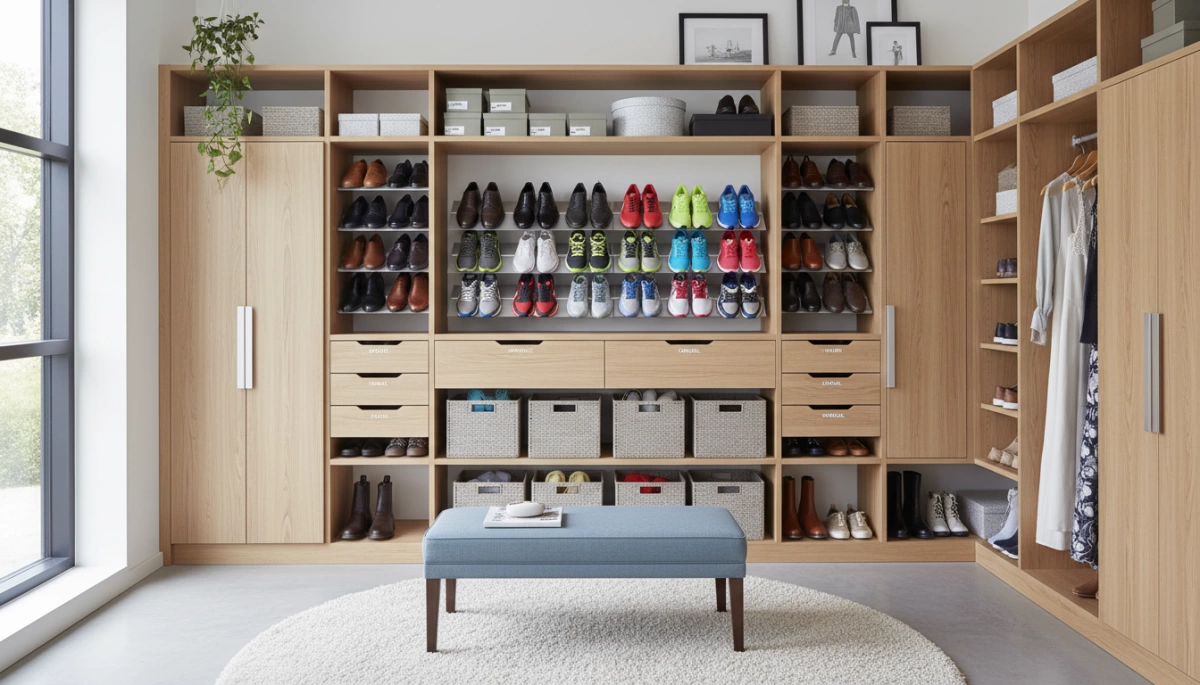
Set Up Easy Shoe Zones
I always design a shoe cabinet with clear “zones” so nobody has to think twice about where shoes go:
- Everyday zone: Front and center, waist height. This is for sneakers, flats, and work shoes you grab daily.
- Occasional zone: Higher or lower shelves for heels, dress shoes, and specialty pairs.
- Seasonal zone: Top shelves or the bottom of a vertical shoe cabinet for boots, sandals, and off-season shoes in bins.
In a busy U.S. household, this kind of layout keeps your entryway shoe cabinet or mudroom shoe cabinet from turning into a pileup.
Use Boxes, Bins, And Dividers
Inside a closed door shoe cabinet or slim profile shoe cabinet, I like to break up space so nothing gets lost:
- Shallow bins for flip-flops, kids’ shoes, and slides.
- Clear boxes for high heel shoe cabinet storage and special pairs.
- Dividers on shelves to separate his/hers or adults/kids.
- Boot shapers or tall bins for boot storage in a shoe cabinet.
These simple organizers turn any shoe organizer cupboard into efficient, space-saving shoe storage.
Label Shelves So Everyone Follows The System
Labels keep a family shoe storage solution running smoothly:
- Use stick-on labels on shelves: “Everyday,” “Sports,” “Kids,” “Guests.”
- For a family shoe storage cabinet, label by name or size so kids know exactly where to put shoes.
- In a small apartment shoe cabinet, label hidden shoe storage cabinet bins so you can find the right pair fast.
Clear labels mean less nagging and fewer random shoes in the hallway.
Quick Reset Routines That Work
To keep a modern shoe cabinet or shoe storage bench cabinet under control, I build in short reset habits:
- Daily: 1–2 minute pickup at night—every pair back into the shoe cabinet.
- Weekly: Wipe shelves quickly, toss trash, and move out-of-season shoes to the “seasonal” zone.
- Monthly: Pull everything out of your entryway shoe cabinet, donate what you don’t wear, and re-sort zones.
These micro-routines keep your shoe cabinet looking clean, organized, and ready for real life, not just photos.
Shoe Cabinet Maintenance And Cleaning Routine
How Often To Clean Your Shoe Cabinet
For most homes in the U.S., a light clean of your shoe cabinet once a week and a deeper clean once a month keeps things under control.
- Weekly: Shake out mats, sweep or vacuum the bottom, and remove any obviously dirty shoes.
- Monthly: Empty shelves, wipe everything down, and check for damage or odors.
- Seasonally: Before spring and winter, pull everything out and reset your whole shoe organizer cupboard so it’s ready for the next season.
This works whether you’re using a slim profile shoe cabinet in a small apartment, a large capacity shoe cabinet in a mudroom, or a vertical shoe cabinet in a narrow hallway.
Wiping Shelves And Drawers
Dirt, sand, and mud add up fast, especially in busy entryway shoe cabinet setups near garages or front doors.
- Use a damp cloth with mild soap to wipe shelves, tilt-out compartments, and drawers.
- For metal shoe storage cabinet interiors, dry right away to prevent rust.
- For engineered wood shoe cabinets (MDF), avoid soaking the surface; wipe dry immediately so it doesn’t swell.
- Add removable mats or liners on each shelf to catch dirt; pull them out, shake, and wipe as needed.
Protecting From Moisture And Salt In Winter
Winter in many parts of the U.S. is rough on any shoe storage bench cabinet or closed door shoe cabinet near an exterior door.
Protect your entryway storage furniture by:
- Using a boot tray or waterproof mat on the bottom level for wet boots and large men’s sneakers.
- Letting shoes air-dry on an open shoe rack first, then moving them into your hidden shoe storage cabinet.
- Wiping away road salt and water quickly so it doesn’t stain or eat into finishes, especially on a solid wood shoe cabinet.
- Adding a small fan or dehumidifier nearby if your mudroom tends to stay damp.
When To Repair, Repaint, Or Replace
At some point, even the best space-saving shoe storage needs a refresh.
Repair or repaint when:
- Hinges on a tilt-out shoe cabinet squeak, loosen, or sag.
- Drawers stick or cabinet doors don’t close flush.
- The finish is scratched but the cabinet frame is still solid.
Replace your shoe cabinet when:
- The structure is warped, soft, or feels unstable.
- Shelves bow under the weight of everyday shoes.
- Odors and moisture damage don’t improve even after cleaning and ventilation upgrades.
If a budget shoe cabinet is constantly breaking, it’s usually time to upgrade to a more durable modern shoe cabinet design that can handle real-life family shoe storage solutions in a busy U.S. household.
Shoe Cabinet Ideas for Small Apartments
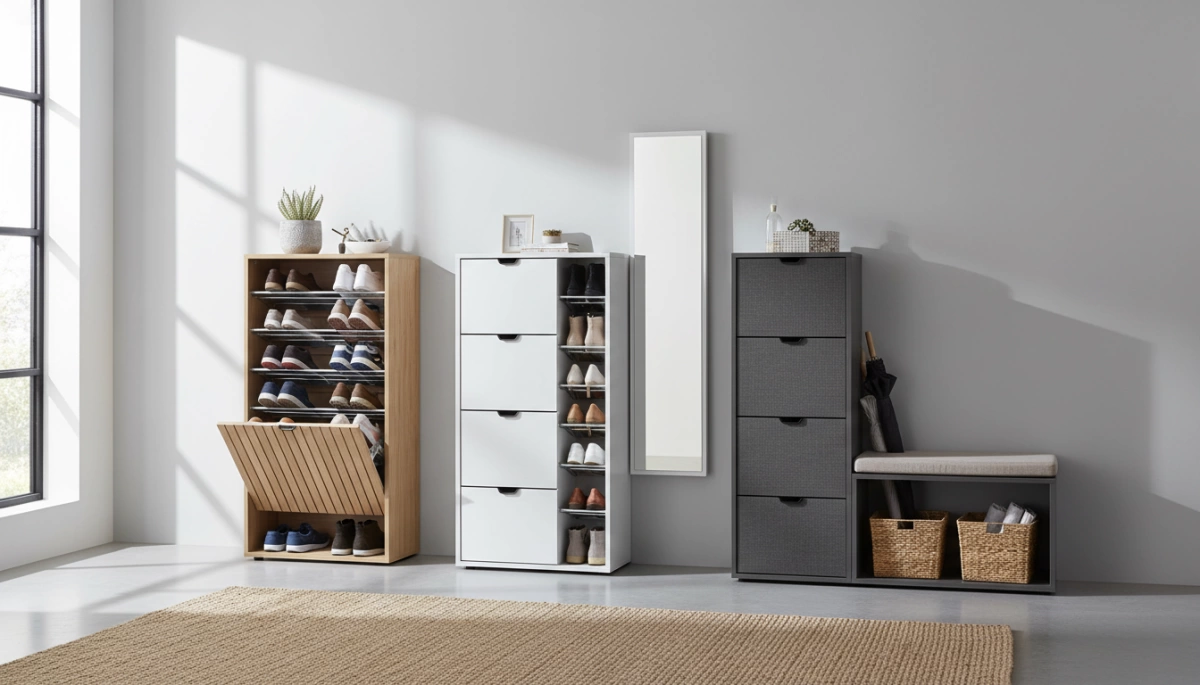
Slim Shoe Cabinet for Tight Entryways
In small U.S. apartments, a slim profile shoe cabinet is usually the best move. I focus on designs that are:
- Under 8–10 inches deep so they fit in narrow entryways and hallways
- Wall-anchored for stability in high-traffic areas
- Closed-door so you don’t see piles of shoes the second you walk in
A slim entryway shoe cabinet keeps sneakers, flats, and sandals off the floor while still leaving room to walk.
Vertical Shoe Cabinet to Save Floor Space
When floor space is tight, I go vertical. A tall vertical shoe cabinet or hidden shoe storage cabinet can:
- Stack 15–30 pairs in a tiny footprint
- Fit between a door and a corner or beside a closet
- Double as entryway storage furniture with hooks or a shelf on top
If your apartment entry is basically a small wall, a vertical shoe cabinet is usually the most space-saving shoe storage solution.
Multi-Purpose Shoe Cabinet Bench for Studios
In a studio apartment, every piece has to multitask. A shoe storage bench cabinet near the door can:
- Offer seating so you can put shoes on comfortably
- Hide daily shoes behind closed doors or tilt-out fronts
- Act as a mini hallway station with baskets, keys, and bags on top
I like a shoe cabinet with seating that’s sturdy, neutral in color, and sized to fit right behind the door without blocking it.
Hiding Shoes in Plain Sight with Discreet Designs
If you don’t want guests to see your shoe stash, go for a modern shoe cabinet design that looks like regular furniture:
- Clean front panels with no visible shoe slots
- Hidden shoe storage cabinet that passes as a console or sideboard
- Colors that match your walls or trim so it visually “disappears”
This way, your small apartment stays calm and uncluttered, but you still get serious, space-saving shoe storage.
Family-Friendly Shoe Cabinet Tips
Simple Shoe Cabinet Rules Everyone Follows
For a busy US household, a family-friendly shoe cabinet only works if everyone plays by the same rules. I keep it simple so no one can claim they “forgot.”
- One spot rule: Everyday shoes live in the entryway shoe cabinet, not in the hallway, not by the couch.
- Two-pair limit per person: Only your main pairs stay in the cabinet; extras go to bedroom or closet storage.
- No dirty shoes inside: Muddy cleats and wet boots stay in a tray or bin under the shoe cabinet or in the garage.
- Reset once a week: Five-minute Sunday reset to clear out random shoes and match up missing pairs.
Kid-Friendly Shoe Cabinet Sections
If kids can’t reach it, they won’t use it. I set up our shoe cabinet so kids can put shoes away on their own.
- Use lower shelves or tilt-out shoe cabinet bins for kid shoes only.
- Add simple picture labels (sneaker, sandals, boots) so younger kids know where each type goes.
- Choose a shoe cabinet with seating so kids can sit, put on shoes, and slide them right back into their section.
- Keep heavy doors or drawers easy to open so they’re safe for little hands.
Extra Space for Guests’ Shoes
In most US homes, guests take off shoes at the door but hate blocking the entry. I always plan guest space into the shoe cabinet layout.
- Reserve one shelf or one tilt-out compartment as “Guest” space.
- Add a small mat or tray next to the shoe cabinet for overflow when you host larger groups.
- Use a slim profile shoe cabinet in a narrow hallway so guests can stash shoes without clogging the walkway.
Separate Zones for Sports Gear and Everyday Shoes
Mixing cleats and sneakers with office shoes is the fastest way to wreck a cabinet and stink up the entryway. I treat sports gear as its own category.
- Dedicate a lower, ventilated zone in the shoe cabinet for cleats, gym shoes, and outdoor sandals.
- Use plastic bins or baskets inside that zone so dirt and turf stay contained.
- Keep everyday pairs (work shoes, school shoes, daily sneakers) on middle shelves for quick grab-and-go.
- If odor is a problem, drop charcoal deodorizers or baking-soda packs in the sports section only, not the whole cabinet.
With clear rules, kid-height sections, guest space, and separate zones for sports gear, a family shoe cabinet turns into a simple, repeatable system instead of a daily fight over piles of shoes.
Budget vs Investment Shoe Cabinet
When a Budget Shoe Cabinet Is Good Enough
A budget shoe cabinet is usually enough if:
- You’re in a rental, small apartment, or temporary place and just need basic entryway shoe cabinet storage.
- You have a small shoe collection (under 10–15 pairs) and mostly sneakers, flats, and sandals.
- You’re okay with a slim profile shoe cabinet made from engineered wood that may not last 10+ years.
- You don’t mind simple modern shoe cabinet design with fewer style options and basic hardware.
In these cases, a low-cost closed door shoe cabinet or simple shoe organizer cupboard keeps shoes off the floor and out of sight without a big spend.
Signs You Should Invest in a Higher-Quality Shoe Cabinet
I recommend upgrading to a more premium shoe storage bench cabinet or solid wood shoe cabinet if:
- Your family tracks in a lot of dirt, snow, and salt, and you need a mudroom shoe cabinet that can handle heavy use.
- You own a large shoe collection with boots, high heels, and big men’s sneakers that need a large capacity shoe cabinet.
- Hinges, tilt-out shoe cabinet mechanisms, or shelves on your current unit keep breaking or sagging.
- You care about long-term style and want a modern shoe cabinet that matches your entryway storage furniture for years.
Quality cabinets (solid wood, metal shoe storage cabinet, or upgraded engineered wood) deliver better stability, stronger hardware, and cleaner lines.
Balancing Price, Durability, and Design
To balance price, durability, and design in a shoe cabinet for a narrow hallway or entryway:
- Pick the right material:
- Engineered wood shoe cabinet: Best for budget and light to moderate use.
- Solid wood shoe cabinet: Best for long-term durability and warmth.
- Metal shoe storage cabinet: Great for high-traffic homes, garages, and mudrooms.
- Prioritize function first: Make sure the cabinet actually fits your space (depth and width), shoes, and door swing.
- Then layer on design: Choose finishes, legs, and hardware that match your other entryway storage furniture and minimalist shoe cabinet style.
Think in years, not months. If you’ll use it daily for 5–10 years, a higher upfront cost usually pays for itself.
Saving Money by Upgrading Your Existing Shoe Cabinet
You don’t always need a brand-new entryway shoe cabinet to level up your space. You can:
- Add extra shelves or dividers to boost capacity inside a closed door shoe cabinet.
- Swap hardware (handles, knobs, legs) for a more modern shoe cabinet design.
- Repaint or refinish an older cabinet to match your current decor.
- Add a cushion on top to turn a basic cabinet into a shoe cabinet with seating.
- Use baskets or bins inside to create hidden shoe storage cabinet zones for kids and guests.
This way you get more organized, more stylish home organization shoe ideas without paying for a full replacement.